


The time to seize the real estate opportunities in Moldova has never been better. Moldova is on the fast track to becoming a full EU member by 2030, with a historic referendum and active negotiations paving the way for economic and legal transformations.
Moldova’s real estate moment: a practical “gateway to Europe”
Moldova is moving through the EU accession process in a way that’s already reshaping its legal, economic, and investment landscape. Accession negotiations formally opened on 25 June 2024 (first Intergovernmental Conference), following the European Council’s December 2023 decision and the Council’s approval of the negotiating framework.
EU integration is no longer theoretical. In September 2025, the European Commission announced Moldova had completed the bilateral screening phase—an important technical milestone that typically precedes the opening of negotiation clusters/chapters.
Trade and regulatory alignment are already in motion.
Moldova’s Association Agreement and DCFTA framework are long-running anchors for trade and standards alignment (and frequently cited as the backbone of Moldova–EU cooperation).
For real estate investors, the takeaway is simple: Moldova remains one of the more affordable European markets, but it’s no longer “sleepy.” Price dynamics, mortgage-driven demand, and EU-alignment reforms are now central to how the market is evolving.
Market insights: what’s actually happening in Chișinău Real Estate Market?
According to Moldova’s 2025 Investor Guide, in 2024 the volume of construction works increased by 4.8% vs. 2023 (comparable prices), while property prices increased by 9.8%—described as the strongest increase in recent years. The same source notes that new apartments in the “white shell” phase cost over €1,400/m², while older buildings are around €970/m² (both figures presented as current levels in that report). This rapid appreciation, however, has led to severe affordability challenges for the local population, precipitating what market experts describe as a "crisis phase".
The most telling indicator of this correction is the collapse in market activity. In the third quarter of 2025, apartment sales plummeted by a staggering 69% compared to the same period in 2024. Overall transaction volumes in the first nine months of 2025 fell to just 5,335, a stark contrast to the more than 11,000 transactions recorded in the corresponding period of the previous year. This is not a collapse in fundamental asset value but rather a profound liquidity crisis. The primary driver is a widening gap between property prices and local purchasing power. The median property price reached €104,500 in early 2025, a figure that has become increasingly detached from the average monthly wage in Chișinău, which stands at approximately €900.
This affordability gap has been exacerbated by tightening financial conditions. Rising mortgage rates, a consequence of central bank policy, have diminished access to credit for local buyers. Concurrently, the government has implemented stricter regulations requiring the justification of the origin of funds for real estate purchases, further dampening transaction volumes. The cumulative effect of these factors has been the effective sidelining of the local, credit-dependent buyer, who traditionally constitutes the majority of market participants. This has created a bifurcated market: a primary, visible market that is largely frozen due to the credit and affordability crunch, and a secondary, less visible market where motivated sellers face a drastically reduced pool of buyers. For a well-capitalized, cash-based international investor, this environment transforms the "crisis" into a strategic, contrarian opportunity to acquire assets on favorable terms from sellers who require liquidity.
The Investment Thesis: Capturing High Yields Amidst the Turmoil
Despite the challenges in the sales market, the underlying investment thesis for Chisinau remains exceptionally compelling, anchored by a robust and fundamentally independent rental market. The city offers an average gross rental yield of 8.65%, a figure significantly higher than those found in most Western European capitals. Yields can vary by location and property type, ranging from 5.22% to as high as 9.60% in specific districts. This high-yield environment is a primary reason a 2025 analysis by UK insurance firm William Russell ranked Moldova as Europe's premier property investment destination.
The strength of the rental market is underpinned by powerful and persistent demand drivers that are distinct from the factors affecting the sales market. Average rents grew by 25-30% in 2024, fueled by internal migration to the capital, continued investment from the Moldovan diaspora, and a structural housing shortage.1 Current estimates suggest that rental demand outstrips supply by 20-30%. This supply-demand imbalance provides a strong foundation for stable rental income and future rental growth, insulating a buy-to-let investor from the volatility of the sales market.
Mortgage programs are influencing demand—and the market mix.
Many specialists indicate the government program “Prima Casă Plus” as a significant factor stimulating demand and mortgage activity. It also an important factor that lead to a rising share of transactions financed via mortgages and pushed the median offer price (based on listing offers) to €105,000 during 2025.
The core investment thesis is therefore to leverage the current sales market dislocation—a buyer's market created by the liquidity crisis—to acquire high-yielding rental assets. The objective is to secure a durable income stream supported by strong rental fundamentals, with the potential for long-term capital appreciation as the market stabilizes and as Moldova progresses on its path toward potential EU accession.
Read More
Moldova offers competitive tax rates and a simplified system designed to encourage foreign investment.




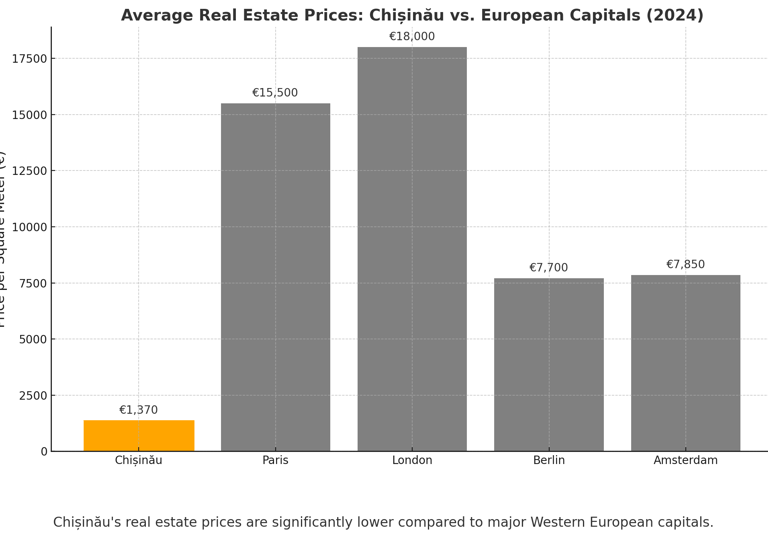
Average Real Estate Prices: Chișinău vs. More European Capitals (2024)
The real estate prices in Chișinău (€1,370 per square meter) are significantly lower than in major European capitals. Chișinău represents the most affordable real estate market in the comparison. It remains far below the average prices even in Eastern Europe.
Chișinău’s low real estate prices are the result of a combination of economic limitations, political factors, and restrained urban growth. However, these same factors also present opportunities for long-term investments, particularly if Moldova experiences economic growth or increased foreign interest.
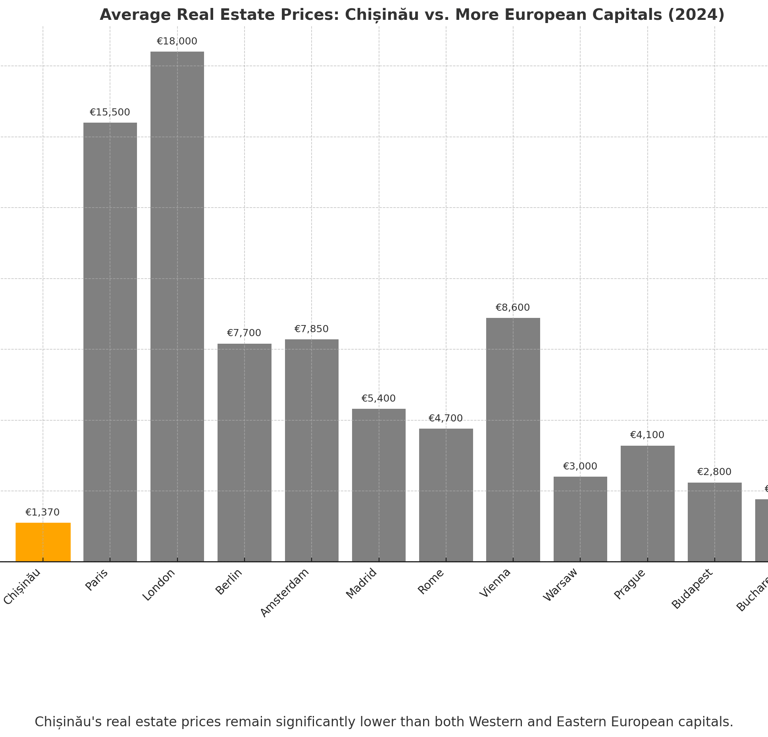
Western Europe vs. Eastern Europe:
Western European capitals like London (€18,000), Paris (€15,500), and Amsterdam (€7,850) have significantly higher average prices per square meter compared to Eastern European cities like Bucharest (€2,200), Budapest (€2,800), and Chișinău (€1,370).
This stark difference underscores the economic disparities and demand in these regions.
Regional Outliers:
Among Eastern European cities, Warsaw (€3,000) and Prague (€4,100) stand out as having moderately higher prices, reflecting stronger economies or increased demand compared to others like Bucharest and Budapest.
Vienna (€8,600) is an outlier within Central Europe, aligning more with Western Europe than its neighbors.
Chișinău as a Bargain Market:
At just €1,370 per square meter, Chișinău represents the most affordable real estate market in the comparison. It remains far below the average prices even in Eastern Europe.
Mid-Tier Markets:
Capitals like Madrid (€5,400) and Rome (€4,700), while part of Southern Europe, show mid-range pricing compared to other Western capitals, reflecting more balanced supply and demand.
Invest in Moldova: A Tax-Friendly Destination for Real Estate Investors
Tax Benefits for Real Estate Investors
1. Low Property Taxes
Moldova boasts some of the lowest property tax rates in Europe, making it cost-effective to own and maintain real estate. Property taxes are calculated based on cadastral value, which is significantly lower than market value.
2. Favorable Income Tax on Rental Revenue
Income from renting out properties is subject to a flat 12% tax rate. This straightforward and competitive rate allows investors to maximize their returns on rental properties.
Why Moldova’s Tax Policies Work for You
Moldova’s tax environment is designed to attract and retain foreign investment. Whether you’re purchasing property to rent out or holding it as a long-term asset, the low taxes and simplified procedures ensure you keep more of your profits.
Start Your Investment Journey Today
Combine Moldova’s tax advantages with its growing real estate market and EU integration momentum to secure a high-return investment. Contact us now to:
Get Expert Tax Guidance
Understand how Moldova’s tax policies can work for your investment strategy.Learn About the Double Taxation Agreement
Our team can help you navigate the benefits of the Israel-Moldova tax treaty.Download Our Moldova Real Estate Tax Guide
Gain a comprehensive overview of tax regulations and benefits for foreign investors.


3. No Wealth Tax
Moldova does not impose wealth taxes, ensuring that high-value property investments remain a financially advantageous choice.
4. Streamlined Tax Filing Process
The Moldovan government has simplified its tax filing process for foreign investors, providing clear guidelines and digital solutions to make compliance hassle-free.
5. Double Taxation Agreement with Israel
Moldova and Israel have a double taxation treaty in place. This ensures that Israeli investors are not taxed twice on their income, allowing them to fully benefit from their investments without additional burdens.
Read More
Tax Benefits for Real Estate Investors
Moldova offers competitive tax rates and a simplified system designed to encourage foreign investment.
Our Services
Average Real Estate Prices: Chișinău vs. More European Capitals (2024)